
- Applies to: Quebec, Canada
- ✓ Verified Nov 1, 2026 · 2 official sources
CRA Compliance Desk · Canadian Sole Proprietor & T2125 Rules
Operating as a Canadian sole proprietor under "Registre Kilometrage Revenu Quebec & Frais de Véhicule Travailleur Autonome (2026)" links every client estimate, GST/HST invoice, T4A slip, and receipt directly into CRA Form T2125 (Statement of Business or Professional Activities), with a June 15 filing deadline and an April 30 payment deadline.
Key Takeaways
- C$30,000 GST/HST Rule: Below C$30,000 in 4 consecutive quarters you are a Small Supplier; once exceeded, register within 29 days and display your 9-digit BN + RT0001 on every invoice.
- T2125 & Dual CPP: Self-employed Canadians contribute 11.9% to base CPP on net earnings between the C$3,500 exemption and the annual YMPE ceiling (50% deductible on Line 22200).
- Key CRA Deadlines: T1/T2125 filing is due June 15 for self-employed individuals and spouses, but any balance owing must be paid by April 30 to avoid daily compound interest.
“Use Form T2125, Statement of Business or Professional Activities, to report your business or professional income and expenses, and keep your supporting receipts and logbooks for six years from the end of the last tax year to which they relate.”
Registre Kilometrage Revenu Quebec & Frais de Véhicule Travailleur Autonome (2026)
Short answer: Under Revenu Québec guide IN-155-V (Form TP-80-V, Part 6 and Line 226) and CRA guide T4002 (Form T2125, Line 9281), a registre kilometrage Revenu Quebec (motor vehicle logbook) is mandatory for every self-employed worker (travailleur autonome) in Québec claiming vehicle expenses. Unlike employees receiving 0,72 $/km, an unincorporated travailleur autonome deducts the business-use percentage (business km ÷ total annual km) of actual vehicle receipts—fuel, SAAQ registration, insurance, maintenance, interest, and Class 10/10.1/54 depreciation (DPA).
⚡ Calculateur de Kilométrage, TP-80-V / T2125 & Facture Gratuite Travailleur Autonome ($CAD): Calculate your Québec business vehicle deduction in the interactive CAD Mileage & Logbook Calculator right below, save your first 5 registres de déplacements, soumissions, or factures TPS/TVQ in the iCloud Web Workspace (5 Free Saves) (or click 🔗 Embed / CSV Template), explore the Québec Travailleur Autonome App Store Edition and Business Mileage Logbook Edition, or Download Keel Free on the App Store ($0/mo) (
quebec-autonome).
Every self-employed contractor, RBQ builder, electrician, plumber, courier, and consultant in Montréal, Québec City, Laval, Gatineau, Longueuil, and Sherbrooke hears the same question at tax time: “Puis-je simplement multiplier mes kilomètres d’affaires par 0,72 $/km sur mon rapport d’impôt TP-80-V et T2125 ?”
The statutory answer from Revenu Québec (Guide IN-155-V — Les revenus d’entreprise ou de profession) and the Canada Revenue Agency (CRA Motor Vehicle Records) is No—and getting that rule wrong is one of the fastest triggers for a dual Revenu Québec / CRA audit adjustment. Below is the complete 2026 Québec self-employed vehicle logbook (registre des déplacements) and expense guide, covering Form TP-80-V (Part 6 & Line 226), Form T2125 (Line 9281), the 12-month base logbook + 3-month simplified logbook rule, 2026 automobile ceilings, and CTI/RTI input tax credits (5% TPS + 9.975% TVQ). For the full form crosswalk, see our Revenu Québec Form TP-80-V & CRA T2125 guide and Québec GST/QST FPZ-500-V invoice guide.
Why can’t a Québec travailleur autonome just claim 0,72 $/km on Form TP-80-V and T2125?
This is the single most important distinction in Québec and Canadian tax law:
| Tax Status in Québec (2026) | Can You Use the Flat Per-Kilometre Rate (0,72 $/km First 5,000 km / 0,66 $/km After)? | How You Must Claim Vehicle Deductions on Your Tax Return |
|---|---|---|
| Unincorporated Travailleur Autonome / Sole Proprietor (Filing TP-80-V & T2125) | NO for income tax deduction (Flat $/km rates are only for employer-to-employee allowances or invoicing a client for travel reimbursement) | Actual Expense × Business % Method: Multiply your total annual receipts (fuel, SAAQ, insurance, maintenance, interest, DPA) by $\frac{\text{Business km}}{\text{Total km}}$ in Part 6 of Form TP-80-V and Chart A of Form T2125 |
| Incorporated Contractor Paying Yourself a Tax-Free Kilometre Allowance (T2 / CO-17 Corporation) | YES — Your corporation can pay you a tax-free allowance of 0,72 $/km (first 5,000 km) and 0,66 $/km thereafter, backed by a trip log | Corporation deducts the allowance; you do not report it as personal T4/RL-1 income |
| Invoicing Your Client for Kilometres Driven to a Jobsite (Refacturation au client) | YES as a billing rate on your invoice (e.g., billing a client 0,72 $/km + TPS/TVQ on your Keel invoice) | The billed mileage is included in your gross business revenue (TP-80-V Line 106/114), and you deduct your actual vehicle expenses on Line 226 |
What must your Registre de Kilométrage (Logbook) contain for Revenu Québec and the CRA?
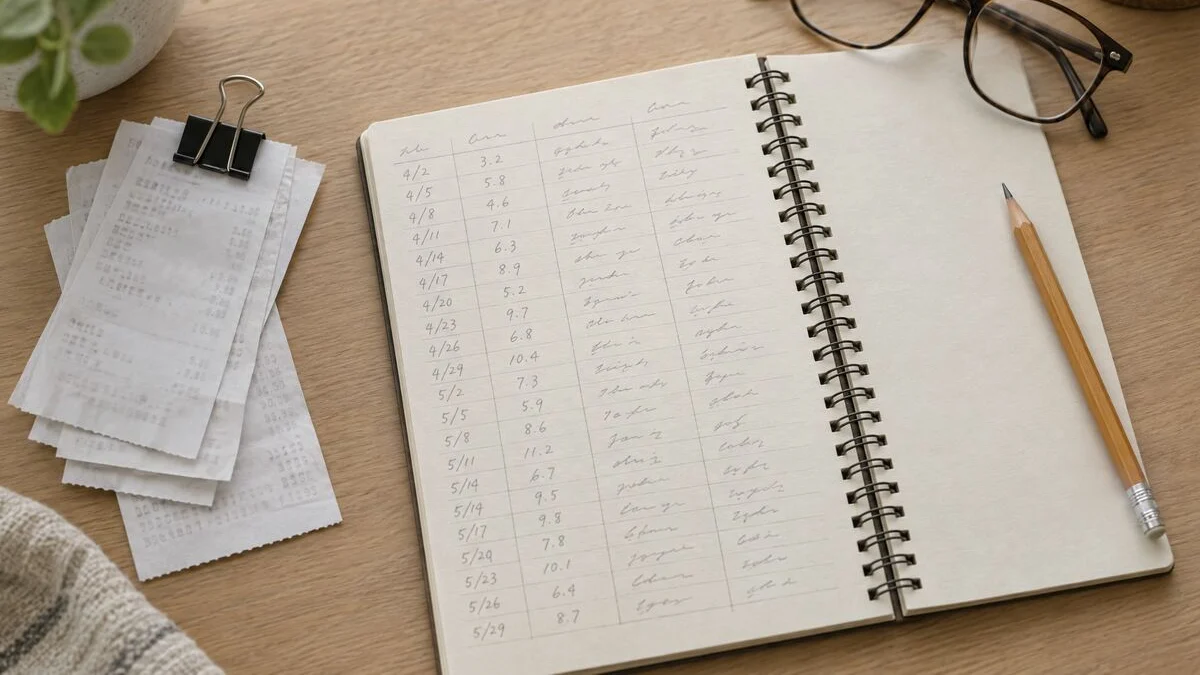
Both Revenu Québec and the CRA require a logbook (registre des déplacements) covering the entire tax year—or a 3-month sample logbook once you have completed one full 12-month baseline year.
1. What Every Trip Entry Must Show (Registre Complet)
For each business trip (déplacement d’affaires), record:
- Date of the trip (Date du déplacement);
- Starting point and destination (Lieu de départ et destination — e.g., “Atelier Laval $\to$ Chantier 450 rue Saint-Denis Montréal $\to$ Réno-Dépôt Anjou”);
- Business purpose (Motif professionnel — e.g., “Soumission rénovation salle de bain — Client Tremblay”, never just “Affaires”);
- Exact kilometres driven (Nombre de kilomètres parcourus).
- Plus your vehicle’s odometer reading on January 1 and December 31 (lecture de l’odomètre au début et à la fin de l’exercice) so your Total Annual Kilometres is locked in.
2. The 3-Month Simplified Logbook Rule (Registre Simplifié de 3 Mois)
Once you have kept a complete 12-month logbook for one full baseline calendar year (année de base) to establish your normal business-use percentage (say, 76%), both Revenu Québec and the CRA allow you to keep a 3-month continuous sample logbook in subsequent years—provided your business usage during the 3-month sample stays within 10 percentage points (i.e., between 66% and 86%) of your baseline year!
3. Home-to-Client vs Home-to-Workshop Travel (Domicile $\leftrightarrow$ Lieu d’affaires)
- If you drive from your home to a separate rented workshop or office, that commute is personal driving (déplacement personnel).
- If your home is your principal place of business (principal établissement d’affaires)—where you prepare quotes (soumissions), issue invoices, and store tools—driving from your home directly to a client’s jobsite, a hardware supplier (BMR, Patrick Morin, Rona), or the bank is 100% business mileage.
What are the 2026 Québec (TP-80-V Part 6) & Federal (T2125) Vehicle Expense Ceilings?
Both Revenu Québec and the CRA distinguish between a “passenger vehicle” (voiture de tourisme)—which is subject to capital cost, interest, and leasing ceilings—and an eligible “motor vehicle / work truck or van” (véhicule à moteur autre qu’une voiture de tourisme), which has no dollar ceiling:
| Expense or Ceiling Category (2026 Rules) | Passenger Vehicle (Voiture de tourisme — Class 10.1 / 54) | Eligible Work Pickup Truck or Cargo Van (Camion de travail / Fourgonnette — Class 10) |
|---|---|---|
| Fuel, Electricity, Oil, SAAQ Registration, Insurance, Tires & Maintenance | Deductible at Business-Use % (e.g., 80%) with dated receipts | Deductible at Business-Use % (e.g., 80% or 95%) with dated receipts |
| Capital Cost Allowance (DPA / Depreciation Ceiling) | Class 10.1: Capped at $37,000 + TPS/TVQ (30% declining balance, half-year rule in Year 1) Class 54 (Zero-Emission EV): Capped at $61,000 + TPS/TVQ | Class 10: No $37,000 cap! 100% of the truck/van purchase price goes into Class 10 (30% declining balance) if used >50% (extended cab pickup used 90%+ for hauling tools/crew) or 100% cargo van |
| Vehicle Loan Interest (Intérêts sur prêt auto — TP-80-V Line 438) | Capped at $350/month (~$11.50/day) before applying Business-Use % | No monthly dollar cap — full loan interest × Business-Use % |
| Leasing Costs (Frais de location — TP-80-V Line 439) | Capped at $1,050/month + TPS/TVQ before applying Business-Use % | No monthly dollar cap — full lease payment × Business-Use % |
How do you claim TPS (5%) and TVQ (9.975%) Input Tax Credits (CTI / RTI) on vehicle expenses in Québec?
If you are registered for TPS/TVQ (mandatory above $30,000 turnover; see our impôt travailleur autonome moins de 30 000 $ guide), your logbook business percentage also governs how much 5% TPS (CTI) and 9.975% TVQ (RTI) you recover on Form FPZ-500-V:
- Operating expenses (fuel, repairs, maintenance, tires): Claim CTI and RTI equal to your business-use percentage (e.g., if your logbook shows
80%business use, claim80%of the TPS and TVQ paid on every fuel and garage receipt—note that SAAQ registration and insurance premiums are tax-exempt and carry $0 TPS/TVQ). - Purchasing a vehicle: For a passenger vehicle used less than 90% in commercial activities, you recover TPS/TVQ gradually each year based on the capital cost allowance (DPA) you claim on your income tax return (
5/105for TPS and9.975/109.975for TVQ, subject to the $37,000 passenger vehicle cap). If a commercial truck/van is used 90% or more for business, you can claim 100% of the TPS and TVQ upfront in the reporting period you bought it!
How do you export your Québec logbook and receipts for Form TP-80-V and T2125?
At the end of the calendar year (December 31), exporting your trip log and vehicle receipts from a single local-first ledger gives your accountant—or your tax software—every number needed for Part 6 of Form TP-80-V and Chart A of Form T2125:
- Odometer Summary: January 1 opening odometer, December 31 closing odometer, total annual km, and business km percentage.
- Categorised Receipts: Fuel, SAAQ registration, commercial insurance, maintenance/tires, and loan interest separated from 5% TPS (CTI) and 9.975% TVQ (RTI).
Frequently asked questions
Combien d’années dois-je conserver mon registre de kilométrage et mes reçus d’essence au Québec ?
Under section 34 of the Tax Administration Act (Québec) and section 230 of the federal Income Tax Act, you must keep your motor vehicle logbook (registre des déplacements), odometer photos, and fuel/maintenance receipts for at least 6 years after the end of the last taxation year to which they relate. If you use a 12-month baseline year to support a 3-month simplified logbook in later years, you must keep that baseline year’s logbook for 6 years after the last year you rely on it.
Where do motor vehicle expenses go on Revenu Québec Form TP-80-V and CRA Form T2125?
On Revenu Québec Form TP-80-V, you complete the motor vehicle worksheet in Part 6 (lines 422 to 444) and carry the deductible business portion to Line 226 (Frais de véhicule à moteur), while vehicle depreciation goes into Part 7 (Déduction pour amortissement — DPA) and Line 246. On CRA Form T2125, you complete Chart A (Motor vehicle expenses) and enter the deductible business amount on Line 9281.
Does an iPhone mileage app logbook satisfy Revenu Québec and the CRA?
Yes. Both Revenu Québec and the CRA accept electronic logbooks exported as a PDF or CSV, provided every business trip records the date, origin, destination, specific business purpose, and kilometres driven, alongside the vehicle’s opening (January 1) and closing (December 31) odometer readings.
Can an unincorporated travailleur autonome claim 0,72 $/km instead of actual vehicle expenses?
No. Both Revenu Québec (IN-155-V) and the CRA (T4002) require unincorporated self-employed individuals to deduct the business-use percentage of actual motor vehicle expenses supported by receipts and a logbook. The flat 0,72 $/km and 0,66 $/km rates apply only to tax-free allowances paid by a corporation to an employee/director or as a billing rate charged to clients.
How does the 3-month simplified logbook rule work in Québec?
After you maintain a complete 12-month motor vehicle logbook for one full baseline calendar year to establish your business-use percentage, you may use a continuous 3-month sample logbook in subsequent years as long as your business usage during the 3-month sample remains within 10 percentage points of the baseline year’s percentage.
| CRA Filing Component | Statutory Rule / Form | C$90,000 Gross Revenue Example | Net Tax / Cash Impact (CAD) |
|---|---|---|---|
| Gross Revenue + 13% ON HST Collected | CRA RC4022 (Mandatory > C$30,000) | C$90,000 revenue + C$11,700 HST | C$11,700 HST held in trust |
| T2125 Expenses & Input Tax Credits (ITCs) | C$22,000 expenses + C$2,860 HST paid | Net T2125 Profit: C$68,000 | Remit C$8,840 net HST to CRA |
| Self-Employed CPP Contributions | Schedule 8 (11.9% on net earnings > C$3,500) | C$64,500 pensionable × 11.9% | C$7,676 CPP (C$3,838 tax-deductible) |
| Federal + Provincial Income Tax | T1 General (15% / 20.5% federal + provincial) | Taxable income after CPP deduction | ~C$11,450 income tax (due April 30) |
Based on CRA Guide T4002 and RC4022. Quarterly CRA tax instalments apply once net tax owing exceeds C$3,000 in two consecutive years.
Create a CRA-Compliant GST/HST Invoice
Generate clean Canadian contractor and freelancer invoices in our free invoice creator and invoice maker with automatic GST/HST/PST line items.
Next
What do I owe, and when?
Alberta Contractor Insurance Requirements: WCB, Warranty, Security
When the first job is booked, Keel keeps the invoices and receipts for it.What do I owe, and when?
Knowledge Graph · Interactive Mind Map