
- Applies to: United States
- Contractors & trades
- ✓ Verified Nov 2, 2026 · 1 official source
Trade Cash-Flow & Contract Rules · Handyman & Home Repair
Managing handyman & home repair partial payments and progress draws requires tying each draw to a physical milestone (30% mobilization deposit of $208, mid-job rough-in/prep draw, and completion balance of $486) and issuing a running-balance receipt whenever a check is short.
Key Takeaways
- Upfront protection: Collect a 30% deposit ($208) so you never finance $135 of handyman & home repair materials out of pocket.
- Enforce Net-Due-on-Completion terms with a stated 1.5%/month (18% APR) contractual late fee and state Preliminary Notice rights.
- Document completion with timestamped job photos, signed walkthrough approval, and an itemized invoice referencing State minor-work handyman exemption thresholds & trade licensing boundaries.
“Every person who performs labor upon or furnishes material to be used in the construction, alteration, or repair of any building or structure shall have a lien upon the property for the work or labor done or materials furnished.”
Handyman Partial Payment & Milestone Billing Guide for Handymans (2026)
Short answer: Handling a handyman partial payment requires separating planned milestone draws from an unexpected short-pay: on multi-day handyman jobs (a punch list or furniture assembly), schedule a 30% upfront draw for Fasteners, drywall patch kits, trim lumber, caulk & replacement fixtures (Line 22) (~$135) followed by physical completion milestones per half-day / punch-list block; if a customer unexpectedly short-pays your final invoice, credit the partial payment on the same invoice number and send an immediate Balance Due Statement.
⚡ Instant Contractor Toolkit (
🔗 Embed / CSV Template+5 Free Saves): Open the Interactive Contractor Invoice & Work Order Generator (or click🔗 Embed / CSV Template), save up to 5 Free Saves in your iCloud Web Workspace, explore the Customer Dossier & Job Proof App Store Edition, or Download Keel on the App Store ($0/moCore Plan) to manage estimates, invoices, job-site receipts, and IRS mileage offline on iPhone.
What is the difference between planned handyman progress draws and an unexpected short-pay?
Avoiding the most expensive cash-flow traps in residential and commercial handyman requires distinguishing two completely different scenarios that both involve a handyman partial payment:
- Planned Milestone Progress Billing: When a handyman takes on a multi-day project like furniture assembly or a repair visit (5+ hours at $90/hr and ~$135 in materials), splitting the contract into a 30% deposit and physical stage draws prevents you from financing the client’s property out of your own pocket.
- Unplanned Short-Pay at Completion: You finish a punch list, present the final invoice for $4122.00, and the customer pays only part of the balance—often citing cash-flow timing or questioning a line item like Labour or forgetting to bill the $75 trip/setup charge, unrecorded Return visit, and Fasteners, drywall patch kits, trim lumber, caulk & replacement fixtures (Line 22).
See how payment schedules link to handyman invoice template, handyman deposit invoice, and handyman customer won’t pay.
How should a handyman tie progress payments to physical half-day / punch-list block milestones?
Never tie a handyman partial payment schedule on furniture assembly to vague calendar dates or “50% halfway done”—because a homeowner and a handyman never judge “halfway” the same way. Anchor every draw to a verifiable physical event governed by State minor-work handyman exemption thresholds & trade licensing boundaries:
| Handyman Operational Benchmark — Milestone draw structure | Field Standard for Solo Handymans |
|---|---|
| Primary Pricing Unit & Rate | $320–$680 per half-day / punch-list block ($90/hr + $75 trip fee) |
| Upfront Deposit Benchmark | 30% deposit on multi-day/material jobs (30% upfront deposit on multi-day or material-staged handyman jobs (100% on completion for single-visit service calls)) |
| Wholesale Material Markup | 25% markup on Fasteners, drywall patch kits, trim lumber, caulk & replacement fixtures (Line 22) (~$135 sample materials) |
| Common Scope Additions | Half-day block, Materials plus markup, and expedited handyman scheduling |
| Code & Permit Standard | State minor-work handyman exemption thresholds & trade licensing boundaries (typical permit allowance: $0) |
| Key Deductible Expenses | Fasteners, drywall patch kits, trim lumber, caulk & replacement fixtures (Line 22); Cordless combo kits, oscillating multi-tools, stud finders & ladders (Line 18) |
| Vehicle & Route Deduction | Multi-stop daily route mileage between hardware stores and client homes (Line 9) |
| Frequent Billing Gotcha | forgetting to bill the $75 trip/setup charge, unrecorded Return visit, and Fasteners, drywall patch kits, trim lumber, caulk & replacement fixtures (Line 22) |
- Draw 1 — 30% Booking & Material Staging: Due upon estimate approval to order Fasteners, drywall patch kits, trim lumber, caulk & replacement fixtures (Line 22) and file any $0 permit paperwork.
- Draw 2 — Prep / Rough-In Milestone (Multi-Day Handyman Jobs): Due when Minimum call-out and Labour are completed on site.
- Draw 3 — Substantial Completion & Walkthrough: Due the moment Half-day block is finished and inspected under State minor-work handyman exemption thresholds & trade licensing boundaries.
How do you record a partial payment on a handyman invoice without losing the balance trail?
Whether a customer is paying Draw #2 on a repair visit or making a partial payment toward a completed a punch list ticket, keep every dollar attached to the original sequential invoice number:
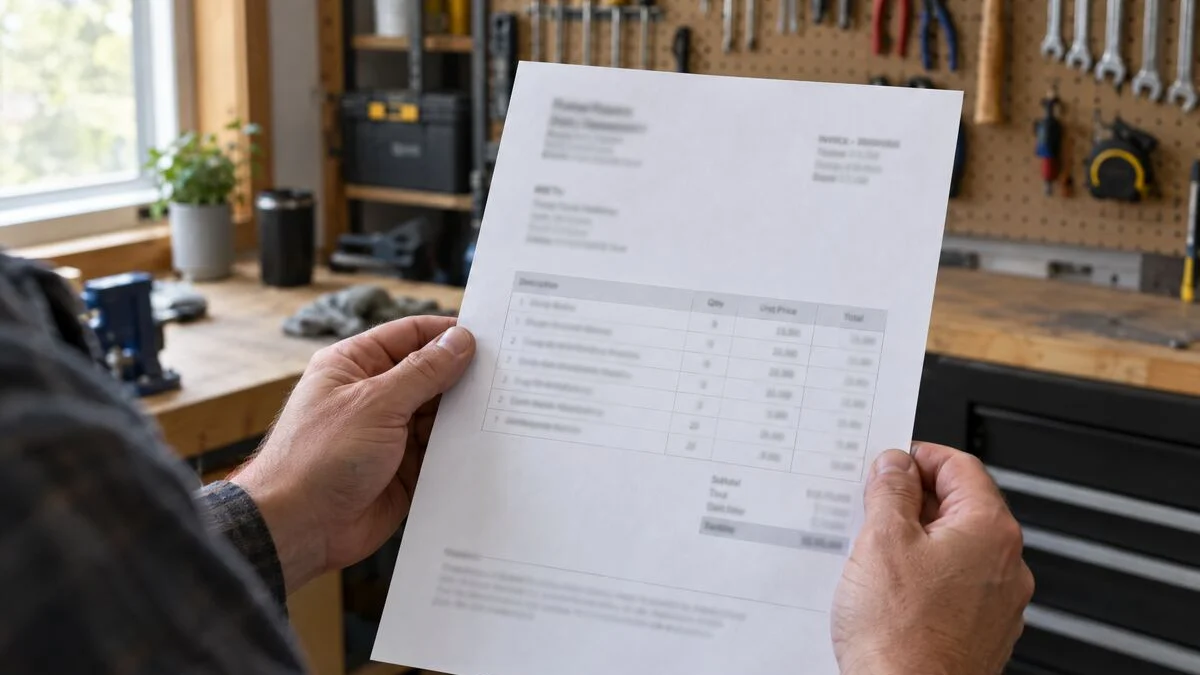
| Handyman Scope Line (progress & balance ledger) | Quantity & Unit (half-day / punch-list block) | Unit Rate (USD) | Extended Line Total |
|---|---|---|---|
| Minimum call-out (progress & balance ledger) | 5 flat | $71.34 | $356.70 |
| Labour | 3 hours | $117.75 | $353.25 |
| Half-day block | 3 block | $55.87 | $167.61 |
| Materials plus markup | 5 flat | $102.28 | $511.40 |
| Travel between sites | 5 flat | $148.69 | $743.45 |
| Debris disposal | 8 flat | $86.81 | $694.48 |
| Ladder / access equipment | 7 flat | $133.22 | $932.54 |
| Return visit | 10 visit | $71.34 | $713.40 |
| Handyman Ticket Subtotal (progress & balance ledger) | Billed per half-day / punch-list block | $90/hr benchmark | $4472.83 |
When the client pays 60% of this handyman ticket today, log the exact payment date and method on the invoice, display Less Partial Payment Received, and email/text the updated PDF showing the exact Remaining Balance Due and due date.
Why must a handyman watch out for “Paid in Full” memo lines on partial checks?
Under Uniform Commercial Code § 3-311 (Accord and Satisfaction) and state contract rules referenced in U.S. Small Business Administration (SBA) Contract & Invoicing Standards, depositing a short-paid check can be a costly legal trap for a handyman:
- The “Paid in Full” Trap on Disputed Handyman Bills: If a client disputes your charge for Half-day block or forgetting to bill the $75 trip/setup charge, unrecorded Return visit, and Fasteners, drywall patch kits, trim lumber, caulk & replacement fixtures (Line 22) and hands you a partial check with “Paid in Full” written in the memo line, cashing that check in many states legally extinguishes your right to collect the remaining balance!
- Safe Handling Protocol: If the partial payment is simply an agreed two-part payment plan on a punch list, get a quick text or email reply from the customer confirming the remaining dollar balance and payment date before depositing. If there is a dispute and the check says “Paid in Full,” demand a clean replacement payment or written settlement agreement first.
How do lien waivers and Schedule C taxes work on handyman partial payments?
Protect both your legal collection rights and your tax ledger whenever you accept a handyman partial payment:
- Use Only a Conditional Partial Lien Waiver: If a general contractor or property manager requests a lien waiver for a progress draw on furniture assembly, sign only a Conditional Waiver and Release on Progress Payment limited to the exact dollar amount received—never an Unconditional Final Waiver.
- Cash-Basis Tax Timing (IRS Pub 334): Report each partial payment in the tax year the funds are received, while deducting Fasteners, drywall patch kits, trim lumber, caulk & replacement fixtures (Line 22), Cordless combo kits, oscillating multi-tools, stud finders & ladders (Line 18), and Multi-stop daily route mileage between hardware stores and client homes (Line 9) in the year you pay for them.
Can a handyman document partial payments, changes, and final invoices without a laptop?
Yes. With Keel on your iPhone, a solo handyman can document handyman partial payment before pulling out of the driveway—generating clean half-day / punch-list block PDF estimates and invoices, attaching supply-house receipt photos (Cordless combo kits, oscillating multi-tools, stud finders & ladders (Line 18)), and recording business miles on-device with no bank connection. Free to download on the App Store.
How should a handyman reconcile 25% material markups and partial payments each quarter?
Cross-checking your billed half-day / punch-list block quantities for handyman partial payments against supplier receipts (Fasteners, drywall patch kits, trim lumber, caulk & replacement fixtures (Line 22)) at the end of each quarter—in line with U.S. Small Business Administration (SBA) Contract & Invoicing Standards—shows immediately whether your $90/hr target rate and 25% markup are holding up.
Frequently asked questions
Should a handyman accept a partial payment if a homeowner cannot pay the full handyman invoice today?
Yes—taking 50% to 75% of the balance on site immediately reduces your exposure on a punch list while you are still in the driveway. Log the partial payment on your handyman invoice, get a written text or signed note confirming the exact date the remainder will be paid, and calendar your state’s mechanics’ lien deadline.
Can cashing a partial check marked “Paid in Full” cancel the rest of my handyman invoice?
Yes. Under UCC § 3-311 in most states, depositing a check marked “Paid in Full” or “Full Settlement” on a disputed handyman bill can legally bar you from collecting the remaining balance—even if you cross out the memo line before depositing the check. Keeping your sequential handyman client invoices, dated supply-house receipts, and signed scope approvals organized by job address ensures you can verify every figure during a customer walkthrough or tax review.
What lien waiver should a handyman sign when collecting a progress draw?
Sign only a “Conditional Waiver and Release on Progress Payment” that specifies the exact partial dollar amount and through-date for Minimum call-out. Never sign an Unconditional Final Lien Waiver until 100% of the handyman contract and change orders have cleared your bank. Keeping your sequential handyman client invoices, dated supply-house receipts, and signed scope approvals organized by job address ensures you can verify every figure during a customer walkthrough or tax review.
How do I structure milestone payments on a larger handyman job like furniture assembly?
Start with a 30% deposit to fund Fasteners, drywall patch kits, trim lumber, caulk & replacement fixtures (Line 22) (~$135) and $0 permit prep, add a mid-job milestone tied to physical completion of Minimum call-out, and collect the final balance upon walkthrough under State minor-work handyman exemption thresholds & trade licensing boundaries.
Does my 1-year handyman workmanship warranty apply if the customer only made a partial payment?
State clearly in your handyman estimate and invoice terms that your workmanship warranty and any non-statutory coverage under State minor-work handyman exemption thresholds & trade licensing boundaries take effect only after 100% of the contract balance is paid in full. Keeping your sequential handyman client invoices, dated supply-house receipts, and signed scope approvals organized by job address ensures you can verify every figure during a customer walkthrough or tax review.
This guide provides general educational and operational information for handyman contractors as of 2026 and does not constitute formal legal or tax advice. Consult U.S. Small Business Administration (SBA) Contract & Invoicing Standards and a qualified professional for rules in your jurisdiction.
| Billing Milestone / Stage | Contractual Trigger | Calculation Basis | Dollar Amount |
|---|---|---|---|
| Milestone 1: Mobilization Deposit | Signed estimate prior to material order | 30% of $694 base bid | $208.00 |
| Signed Change Order (CO #1) | Hidden site condition / added client scope | 3 hrs @ $90/hr + materials | +$317.00 |
| Milestone 2: Completion Balance | Final walkthrough & inspection sign-off | Remaining 70% base contract | $486.00 |
| 30-Day Overdue Late Fee (1.5%/mo) | Unpaid past grace period before lien notice | 1.5% × $486 unpaid balance | +$7.29 |
Statutory mechanic’s lien preliminary notice deadlines typically run 20 to 60 days from first furnishing labor or materials.
Ready to bill the job?
Create and keep your invoices with Keel.
Pick the customer, add the lines, send a clean PDF.
Free to download · No bank connection · See invoices in Keel
What do I keep?
Knowledge Graph · Interactive Mind Map